
Schema: Notifications and Email
Free & ProReference for the four tables that back BuddyNext's notification and email subsystem: bn_notifications, bn_notification_prefs, bn_email_templates, and bn_email_log. All four are created by BuddyNext\Core\Installer via dbDelta() and live in the site table prefix (shown below as wp_). This page is for developers reading, extending, or writing against these tables directly.
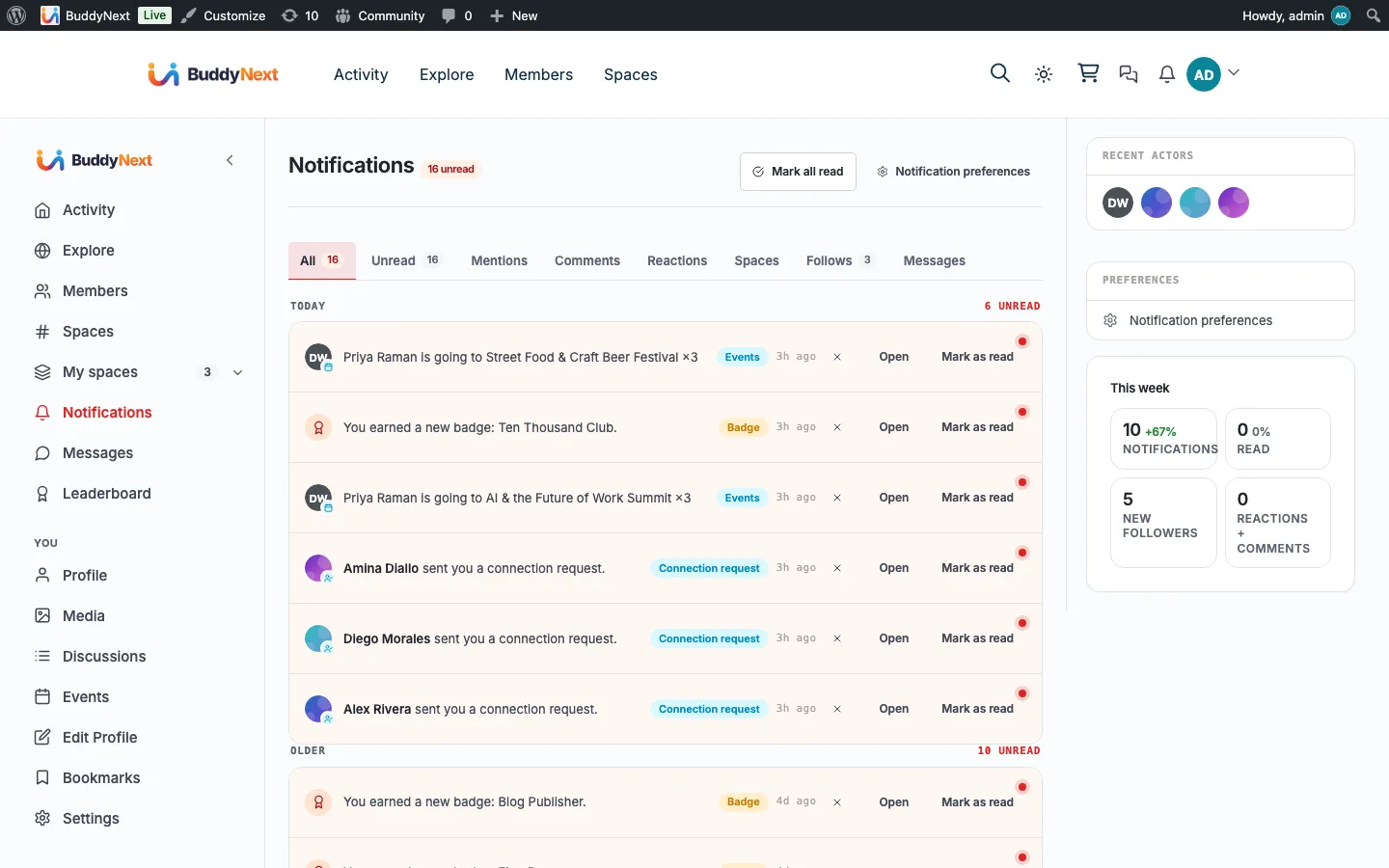
Overview / Contract
The notification and email subsystem follows the one-channel-plus-preference model documented in the notification contract:
- Every event fans in through
NotificationService::create(), which inserts onebn_notificationsrow and firesdo_action('buddynext_notification_created', ...). - In-app delivery is the
bn_notificationsrow itself, read back through the bell endpoint. - Email delivery is a separate listener that is gated by the recipient's
bn_notification_prefsrow for that notificationtype(theemail_freqcolumn). - Email copy comes from
bn_email_templates, keyed by templatetype. A composed email (campaign / drip) can pass its own subject and body and bypass the template row entirely. bn_email_logrecords what was actually sent, so digest batching and per-period dedup can be enforced.
Two design notes that shaped the schema:
- Group aggregation on
bn_notifications. Rather than show fifteen separate "X reacted to your post" rows, the table carriesgroup_key+group_countso repeat events on the same object collapse into a single bell row with an incrementing counter. See the column notes below. - Per-type, per-channel preferences.
bn_notification_prefsis keyed by(user_id, type)and stores one on-site flag plus one email-frequency enum per type, so a member can mute one notification category on one channel without affecting the rest.
bn_notifications
One row per in-app notification. The primary read path is the bell: notifications for a recipient, newest first, filtered by read state.
| Column | Type | Notes |
|---|---|---|
id |
BIGINT UNSIGNED AUTO_INCREMENT |
Primary key. |
recipient_id |
BIGINT UNSIGNED NOT NULL |
The user who receives the notification. |
sender_id |
BIGINT UNSIGNED NULL |
The user who triggered it. Null for system notifications. |
type |
VARCHAR(64) NOT NULL |
Notification type slug, e.g. bn.new_follower, bn.post_reacted, bn.mention. Matches the email template type and the preference type. |
object_type |
VARCHAR(32) NULL |
The kind of object the notification points at, e.g. post, comment, space. |
object_id |
BIGINT UNSIGNED NULL |
The id of that object, used to build the deep link. |
group_key |
VARCHAR(128) NULL |
Aggregation key. Events that should collapse into one bell row share a group_key (typically type + object). Null means the row never aggregates. |
group_count |
INT UNSIGNED NOT NULL DEFAULT 1 |
How many underlying events this row represents. Incremented in place when a new event matches an existing unread row with the same group_key, so "5 people reacted to your post" is one row, not five. |
data |
JSON NULL |
Free-form payload for rendering (actor names, snippet text, extra ids). |
is_read |
TINYINT(1) NOT NULL DEFAULT 0 |
Read state. Drives the unread bell count. |
created_at |
DATETIME NOT NULL DEFAULT CURRENT_TIMESTAMP |
Creation time; also the bell sort key. |
Indexes
| Key | Columns | Purpose |
|---|---|---|
PRIMARY |
id |
Row identity. |
bell |
recipient_id, is_read, created_at |
The bell query: a recipient's notifications, filtered by read state, ordered by recency. |
recipient_group |
recipient_id, group_key |
Find an existing aggregatable row for a recipient when deciding whether to increment group_count instead of inserting. |
Relationships
recipient_idandsender_idreference WordPress users (wp_users.ID); not enforced by a foreign key.object_type+object_idis a polymorphic pointer to a BuddyNext object (abn_postsrow, abn_commentsrow, abn_spacesrow, and so on), resolved at render time.typeties a row to itsbn_email_templatesrow and the recipient'sbn_notification_prefsrow of the sametype.
bn_notification_prefs
Per-user, per-type delivery preferences. One row stores the on-site and email choices for a single notification type for a single user. The absence of a row means defaults apply.
| Column | Type | Notes |
|---|---|---|
user_id |
BIGINT UNSIGNED NOT NULL |
The member whose preference this is. Part of the primary key. |
type |
VARCHAR(64) NOT NULL |
The notification type this preference governs, e.g. bn.new_follower. Part of the primary key. Matches bn_notifications.type. |
on_site |
TINYINT(1) NOT NULL DEFAULT 1 |
Whether the in-app (bell) channel is enabled for this type. |
email_freq |
ENUM('immediate','daily','weekly','off') NOT NULL DEFAULT 'immediate' |
The email channel cadence for this type. off suppresses email; daily / weekly route the event into the matching digest instead of an immediate send. |
Indexes
| Key | Columns | Purpose |
|---|---|---|
PRIMARY |
user_id, type |
One preference row per (user, type). Doubles as the lookup key when the dispatcher checks whether to deliver. |
Relationships
user_idreferenceswp_users.ID.typematchesbn_notifications.typeandbn_email_templates.type. The structure is deliberately per-type and per-channel: the on-site channel is a single flag, the email channel is a four-value frequency enum, and each type carries its own pair. A missing row means the member has never changed that type, so the dispatcher applies the seeded defaults.
bn_email_templates
The catalog of email templates, one row per template type. Seeded on install with the built-in transactional, moderation, and digest templates (idempotent INSERT IGNORE, so customised rows are never overwritten on upgrade).
| Column | Type | Notes |
|---|---|---|
id |
BIGINT UNSIGNED AUTO_INCREMENT |
Primary key. |
type |
VARCHAR(64) NOT NULL |
Unique template slug, e.g. welcome, email_verify, bn.new_follower, bn.daily_digest. The lookup key when an event renders its email. |
subject |
VARCHAR(255) NOT NULL |
Email subject line. Supports {{token}} placeholders, e.g. {{site_name}}. |
preview_text |
VARCHAR(255) NULL |
Inbox preview / preheader text. |
body_html |
LONGTEXT NOT NULL |
The HTML body. Supports {{token}} placeholders such as {{user_name}}, {{action_url}}, {{unsubscribe_url}}, and (for digests) {{notification_list}}. |
enabled |
TINYINT(1) NOT NULL DEFAULT 1 |
Whether this template's event email is sent. A disabled row suppresses its own event email but never a composed campaign or drip email. |
created_at |
DATETIME NOT NULL DEFAULT CURRENT_TIMESTAMP |
Creation time. |
updated_at |
DATETIME NOT NULL DEFAULT CURRENT_TIMESTAMP ON UPDATE CURRENT_TIMESTAMP |
Auto-updated on every edit. |
Indexes
| Key | Columns | Purpose |
|---|---|---|
PRIMARY |
id |
Row identity. |
type (UNIQUE) |
type |
One template per type; the lookup key for an event's email. The unique constraint is what makes the seeder's INSERT IGNORE idempotent. |
Relationships
typematchesbn_notifications.typeandbn_notification_prefs.typefor event-driven emails (e.g.bn.new_follower). Some template types are not event notifications (e.g.welcome,email_verify,bn.daily_digest,bn.bulk_invite) and are rendered directly by their sender.
bn_email_log
A record of emails actually sent, primarily so digest batching can be deduped per period and per type.
| Column | Type | Notes |
|---|---|---|
id |
BIGINT UNSIGNED AUTO_INCREMENT |
Primary key. |
user_id |
BIGINT UNSIGNED NOT NULL |
Recipient of the email. |
type |
VARCHAR(64) NOT NULL |
The template / email type that was sent. |
digest_date |
DATE NULL |
The period a digest covers. Null for non-digest (immediate) emails. Combined with type and user_id, this prevents sending the same daily/weekly digest twice. |
sent_at |
DATETIME NOT NULL DEFAULT CURRENT_TIMESTAMP |
When the email was sent. |
Indexes
| Key | Columns | Purpose |
|---|---|---|
PRIMARY |
id |
Row identity. |
user_type |
user_id, type, digest_date |
Dedup / lookup: "has this user already been sent this email type for this period?" |
Relationships
user_idreferenceswp_users.ID.typematchesbn_email_templates.type.
Notes / gotchas
- Aggregation is unread-only in practice.
group_countincrements while a matching unread row exists; once read, a fresh event generally starts a new row. Treatgroup_countas "events in this collapsed bell item", not a lifetime total. - A missing preference row is not "off".
bn_notification_prefsis sparse: no row means seeded defaults (on_site = 1,email_freq = immediate). Do not assume a member has opted out just because they have no row for a type. - Disabled template vs disabled channel are different switches.
bn_email_templates.enabled = 0turns off one event email globally;bn_notification_prefs.email_freq = 'off'turns off email for one type for one user. A composed campaign / drip email passes its own subject and body and is gated by neither. digest_dateis the dedup spine for digests. Immediate emails leave it null; daily and weekly digests stamp the covered period so the same digest is never sent twice for the same window.