
Integration Bridges (Layer 1)
Free & ProThe bridge layer is how BuddyNext connects to optional companion plugins (Jetonomy forums, WPMediaVerse media + DM, wb-gamification, Career Board) and the host theme. Each bridge is an adapter class under includes/Bridges/ that translates a companion's hooks and data into BuddyNext surfaces - and stays completely inert when the companion is not installed. This page is for developers writing a new bridge, theming a bridged surface, or extending one of the existing integrations.
Overview / Contract
A bridge is a thin, one-directional adapter. The rules every BuddyNext bridge follows:
- One class per companion,
Bridgesuffix. Adapter classes live inincludes/Bridges/and are named{Companion}Bridge(for exampleJetonomyBridge). A companion that also needs to mirror inbound notifications ships a paired{Companion}BridgeListenerimplementingBuddyNext\Contracts\ListenerInterface. - Self-guarding at hook time, not load time. Every bridge's entry method (
init()for adapters,register()for listeners) bails immediately with aclass_exists()/function_exists()check against the companion. Nothing is registered on a site that does not run the companion, so no hooks are wasted and no fatals occur on activation-order differences. - Loaded on a single seam after everyone else has booted. Bridges are wired on
buddynext_load_bridges, which BuddyNext fires atplugins_loaded:25- after BuddyNext itself (priority 15) and after Pro companions like Jetonomy Pro and WPMediaVerse Pro (priority 20). Activation order between BuddyNext and a companion therefore never matters. - Feature-toggle gated. Each integration bridge is additionally gated on its Platform -> Features toggle via
buddynext_feature_enabled( '{feature}' )(all default-on). Turning a bridge off in the admin actually disables it, independent of whether the companion is active. - BuddyNext owns companion table access. When a bridge needs companion data (for example Jetonomy's
jt_posts/jt_replies), the bridge class is the only place that reads those tables - templates and services never reach into a companion's schema directly.
How bridges are wired
// includes/Core/Plugin.php - fired at plugins_loaded:25
do_action( 'buddynext_load_bridges' );

add_action( 'buddynext_load_bridges', function (): void {
    // Theme bridge - always wired (it self-guards on the active template).
    ( new BuddyXBridge() )->init();

    if ( buddynext_feature_enabled( 'wpmediaverse' ) ) {
        ( new WPMediaVerseBridge() )->init();
    }
    if ( buddynext_feature_enabled( 'gamification' ) ) {
        ( new GamificationBridge() )->init();
        ( new GamificationBridgeListener() )->register();
        ( new \BuddyNext\Profile\GamificationAchievements() )->register();
    }
    if ( buddynext_feature_enabled( 'jetonomy' ) ) {
        ( new JetonomyBridge() )->init();
        ( new JetonomyBridgeListener() )->register();
    }
} );
A third-party bridge attaches the same way - hook buddynext_load_bridges and wire your own adapter inside a feature/class_exists guard.
Bridge -> companion -> key seams
| Bridge | Companion | Guard (active when) | Feature toggle | Key seams |
|---|---|---|---|---|
JetonomyBridge |
Jetonomy (forums) | class_exists( 'Jetonomy\Jetonomy' ) |
jetonomy |
jetonomy_after_create_post, jetonomy_post_deleted, jetonomy_after_create_reply (consume); buddynext_rail_items, buddynext_register_nav, buddynext_context_nav, buddynext_hashtag_related_discussions (provide); REST POST /spaces/{id}/forum |
JetonomyBridgeListener |
Jetonomy | class_exists( 'Jetonomy\Jetonomy' ) |
jetonomy |
jetonomy_notification_created (consume); mirrors into one BN type jt.notification via the three notification render filters |
WPMediaVerseBridge |
WPMediaVerse (media + DM engine) | class_exists( 'WPMediaVerse\Core\Plugin' ) |
wpmediaverse |
mvs_buddynext_active, mvs_can_send_message, mvs_dm_denial_reason, mvs_user_profile_url, mvs_message_sent, mvs_favorite_toggled, mvs_comment_created, mvs_user_followed/unfollowed (consume); fires buddynext_dm_sent / buddynext_dm_received |
GamificationBridge |
wb-gamification | function_exists( 'wb_gam_submit_event' ) |
gamification |
Consumes wb_gam_badge_awarded to post a credential-badge feed activity. Point awards for BuddyNext activity are owned by the wb-gamification plugin's own integrations/buddynext.php manifest, not this bridge. |
GamificationBridgeListener |
wb-gamification | function_exists( 'wb_gam_submit_event' ) |
gamification |
wb_gam_badge_awarded, wb_gam_level_changed (consume) -> BN notifications bn.badge_awarded / bn.level_up |
CareerBoardBridge (registered in Pro) |
Career Board (wp-career-board) |
defined( 'WCB_VERSION' ) guard inside the bridge |
career_board |
wcb_job_created, wcb_job_expired, wcbp_resume_published, wcb_notification_created (consume) -> bn_search_index (object_type='job') + bn_notifications; pure inbound listener |
BuddyXBridge |
BuddyX theme | 'buddyx' === get_template() |
always wired | buddyx_is_full_width_page (provide) so plugin pages escape the theme's .container wrapper |
PwaService (PWA, not a companion bridge) |
none (first-party) | always wired | n/a | Serves the web-app manifest + service worker; opt-out filter buddynext_pwa_register_sw |
JetonomyBridge
Routes Jetonomy forum events into BuddyNext search, the activity feed, the navigation rail, profile and space tabs, and the notification center. Active only when Jetonomy\Jetonomy exists.
Inbound (what it consumes)
| Hook | Type | Fired when | Bridge handler |
|---|---|---|---|
jetonomy_after_create_post |
action (2 args: $post_id, $space_id) |
A discussion is created | on_post_created |
jetonomy_post_deleted |
action (3 args) | A discussion is soft-deleted | on_post_deleted |
jetonomy_after_create_reply |
action (2 args) | A reply is posted | notify_discussion_reply |
On create, the bridge reads the discussion row from {prefix}jt_posts (Jetonomy fires the hook with IDs only), indexes it into bn_search_index as object_type = 'discussion', parses @username mentions (firing buddynext_user_mentioned), and - for a published, non-private topic in a public space - publishes a discussion activity into the feed via Feed\IntegrationActivity. The discussion URL is rebuilt from the jt_posts / jt_spaces slugs as {base}/s/{space}/t/{post}/.
Note: The privacy gate is strict. A private/secret space or a private topic never produces a public feed activity - only the search index entry, which respects its own visibility.
Feed sync option
| Option key | Type | Default | Used by |
|---|---|---|---|
buddynext_jetonomy_feed_sync |
string ('1' / '0') |
'1' (on) |
JetonomyBridge::on_post_created |
Feed sync is on by default whenever Jetonomy is active (the bridge only loads then). The owner can flip it off under Integrations -> Jetonomy Feed Sync; when off, discussions are still indexed for search but no feed activity is published. Per-discussion control is also available through the buddynext_jetonomy_discussion_activity filter (return false to skip a specific post).
Outbound (what it provides)
| Hook / surface | Purpose |
|---|---|
buddynext_rail_items (filter) |
Adds a "Discussions" item to the BuddyNext left rail, linking to the Jetonomy community home. Active state derived from REQUEST_URI. |
buddynext_register_nav (action) |
Registers a "Discussions" tab on both the profile surface (with a lazy count badge of the member's published discussions) and the space surface (linking to the linked forum, or the on-demand provision trigger). |
buddynext_context_nav (filter) |
Injects Home / Search / Leaderboard sub-nav when the active section is discussions. |
buddynext_hashtag_related_discussions (filter) |
Returns Jetonomy discussions sharing a hashtag slug, so the hashtag feed can show "Related Discussions". |
buddynext_jetonomy_post_indexed (action) |
Fires after a discussion is indexed, for per-space sync extensions. |
On-demand space forum
A BuddyNext space links to a Jetonomy forum through the option bn_space_{space_id}_jetonomy_forum_id. The forum is created the first time a member opens a forumless space's Discussions tab (no empty forums are pre-created):
- Web: the tab links to
/spaces/?bn_provision_forum={space_id};maybe_provision_and_redirect()(ontemplate_redirect:5) provisions the forum and redirects to it. - App / REST:
POST /buddynext/v1/spaces/{id}/forumprovisions (or fetches) the forum and returns{ forum_id, forum_url }.
Both paths gate provisioning on buddynext-moderate-space (space owner/moderator, plus site admins) - an arbitrary logged-in member cannot provision a forum on a space they do not moderate.
curl -X POST "https://example.com/wp-json/buddynext/v1/spaces/42/forum" \
  -H "X-WP-Nonce: $NONCE" --cookie "$COOKIES"
# -> { "forum_id": 7, "forum_url": "https://example.com/community/s/general/" }
Messaging precedence
When BuddyNext messaging is available, the bridge filters option_jetonomy_pro_extensions at read time to drop Jetonomy Pro's private-messaging extension, so BuddyNext owns the /messages/ route. Nothing is persisted (the filter only changes the value front-end at read time) and it reverts automatically if BN messaging is disabled. The setting is left untouched in wp-admin so the Jetonomy extensions screen still reflects and saves the real value.
Note: A docblock at the top of
JetonomyBridgereferences suppressing Jetonomy's own community nav viajetonomy_show_community_nav -> false. The current code does not register that filter - per the owner rule that BuddyNext must not touch Jetonomy's own pages. The link into discussions lives on BuddyNext's own rail instead. Treat the manifest/docblock mention as stale; the live behavior is no suppression.
JetonomyBridgeListener
Mirrors every Jetonomy notification (replies, mentions, accepted answers, join requests, votes) into BuddyNext's central notification center, so a member sees forum activity at /notifications/ alongside everything else.
Jetonomy 1.5.0 fires one central hook for all of its notifications:
do_action( 'jetonomy_notification_created', int $notification_id, int $user_id,
    string $type, string $object_type, int $object_id, string $message, string $url );
The listener subscribes with acceptedArgs = 7 but defaults $message and $url so older five-argument firings cannot trigger an ArgumentCountError. Each event is mirrored into a single BuddyNext notification type, jt.notification, with group_key = jt_{subtype}_{object_id} for dedup. The stored message and url are rendered straight through the three Free notification seams (buddynext_notification_message, buddynext_notification_url, buddynext_notification_meta), so there is no per-type copy to maintain.
Two cross-cutting rules:
- Blocks honored. If the actor is resolvable from the object (
jt_replies/jt_postsauthor) and either party has blocked the other (bn_blocks), the notification is suppressed. - Collect-only / no double email. The prefs-catalogue entry registers
can_email = false. Jetonomy owns its own emails; BuddyNext only displays the mirror and never emails it.
WPMediaVerseBridge
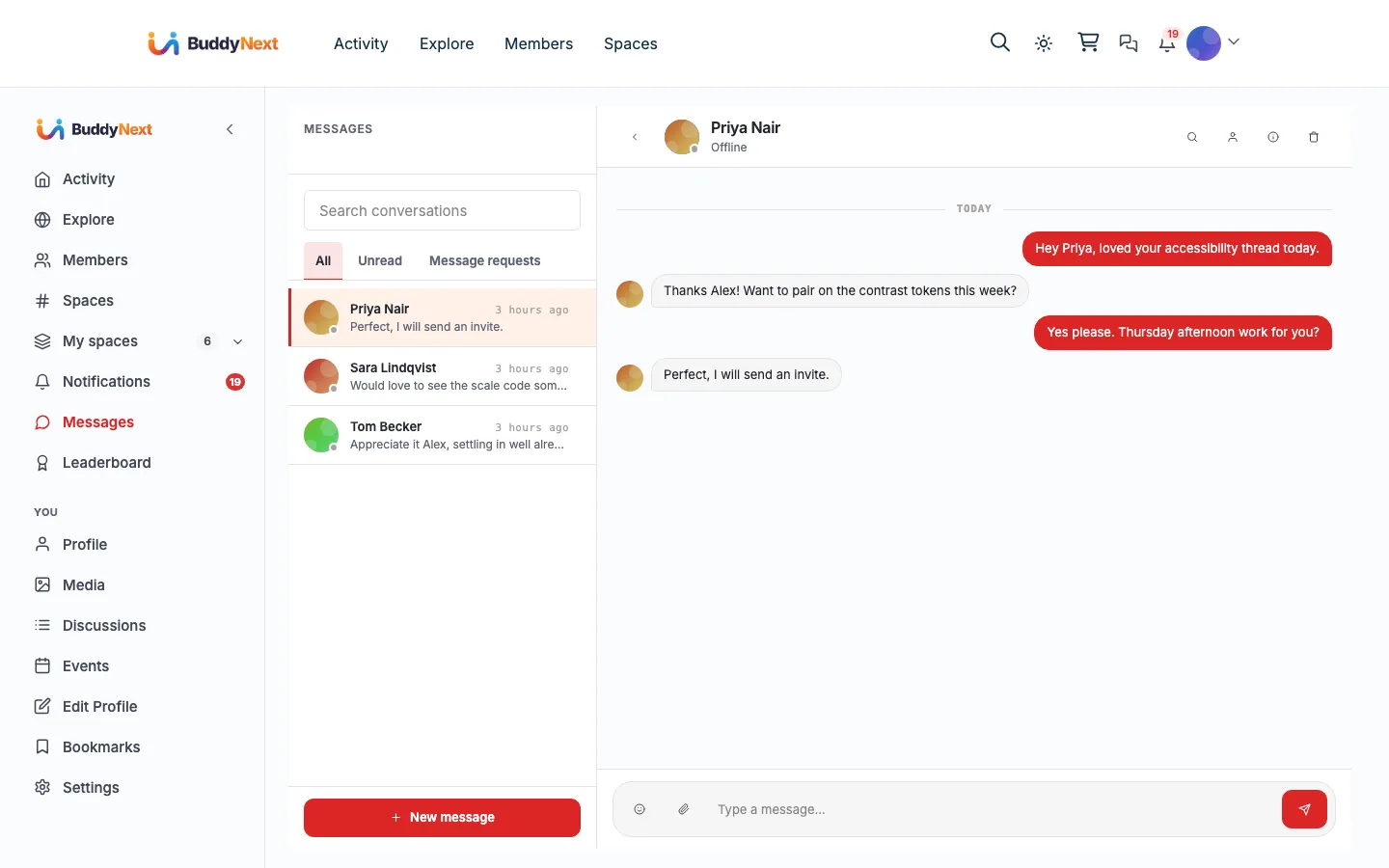
Connects BuddyNext to the WPMediaVerse engine for media and direct messaging. Active only when WPMediaVerse\Core\Plugin exists. BuddyNext consumes WPMediaVerse at the REST/API level only and owns 100% of its own UX - WPMediaVerse JS/CSS is never enqueued on BuddyNext pages, and /messages/ is a fully native BuddyNext surface (templates/messages/native.php) backed by the mvs/v1 REST engine.
Which plugin owns which shared screen - and which of them are still open - is tracked in WPMediaVerse Surface Ownership Map. Read it before building a screen WPMediaVerse also renders.
Declaring BuddyNext active
add_filter( 'mvs_buddynext_active', '__return_true' );
This tells WPMediaVerse to suppress its own floating chat panel, standalone messages page, and duplicate notifications - BuddyNext takes over those surfaces.
DM gating
check_block() layers BuddyNext's access rules on top of WPMediaVerse's own DM controls through mvs_can_send_message (either side can deny; neither overrides the other):
- Site admins (
manage_options) always pass. - A recipient who has blocked the sender (
bn_blocks, via theblocksservicehas_blocked()) denies the send. - The recipient's "who can DM me" preference (
bn_privacy_dmuser meta, falling back to thebuddynext_default_dm_accessoption) is enforced:everyone/members/connections/nobody.
dm_denial_reason() mirrors that logic on mvs_dm_denial_reason so the sender sees an accurate cause - blocked, dms_disabled (the nobody preference), or connections_only - instead of a generic "blocked".
Message + favorite events
| Hook | Type | Result |
|---|---|---|
mvs_message_sent |
action (4 args) | Fires buddynext_dm_sent (sender perspective, once) and buddynext_dm_received (per recipient, sender stripped), then creates bn.new_message notifications. Restrict/mute on the recipient side suppresses the bell without blocking the message. |
mvs_favorite_toggled |
action (3 args) | On 'added' only, notifies the media owner with bn.media_favorited. |
mvs_comment_created |
action | Syncs a lightbox photo comment into a bn_comments row threaded under the BuddyNext post holding the media, then fires buddynext_comment_created (canonical 4-arg). Deduped against re-fires. |
mvs_user_profile_url |
filter | Repoints WPMediaVerse author links at the BuddyNext member profile (PageRouter::profile_url). |
Two-way follow mirror
bn_follows (BuddyNext) and mvs_follows (WPMediaVerse) are kept in sync in both directions so a member's follow state is identical on either profile. The bridge listens on mvs_user_followed/unfollowed and buddynext_user_followed/unfollowed; a re-entrancy guard ($mirroring_follow) plus an is_following() short-circuit prevent the mirror from looping back on itself.
Media rail item
inject_media_nav_item() adds a "Media" link to the BuddyNext left rail, resolving the engine's mapped Explore page (mvs_page_explore) and falling back to /media/. This only adds a link on BuddyNext's own pages - it never alters a WPMediaVerse page.
GamificationBridge and GamificationBridgeListener
The gamification integration is split into a write-side bridge (BuddyNext events -> engine), an inbound listener (engine events -> BuddyNext notifications), and an Achievements profile tab. BuddyNext ships zero gamification logic. It surfaces credential badges in the feed, mirrors badge and level events into notifications, and renders the engine's public read API for the Achievements tab. Point awards for BuddyNext activity are defined in the wb-gamification plugin's own BuddyNext manifest. The full contract is documented on the Gamification Engine Seam page; in summary:
GamificationBridgeposts a feed activity (on_badge_awarded_activityonwb_gam_badge_awarded) when a member earns a credential badge. Point awards for BuddyNext activity (follow, connection accepted, post created, space joined, reaction received, comment created, profile completion, strike issued) are defined in the wb-gamification plugin'sintegrations/buddynext.phpmanifest, not in this bridge.GamificationBridgeListenerconsumeswb_gam_badge_awardedandwb_gam_level_changed(inbound only - it never submits an award, so it cannot double-count) and createsbn.badge_awarded/bn.level_upnotifications.BuddyNext\Profile\GamificationAchievementsregisters an "Achievements" profile tab (badge grid + points/level/streak standing strip) read purely fromwb_gam_*functions. The tab is data-gated - it appears only once the member has a badge or any points.
Note: The conformance record
docs/conformance/contract-gamification-seam.mddescribes profile gamification being surfaced viabuddynext_profile_extra_data. The current implementation surfaces it through the dedicatedGamificationAchievementsprofile tab instead (registered onbuddynext_register_nav); theprofile_extra_datainjection is not present inGamificationBridge. Document the Achievements tab as the live surface.
Career Board bridge (registered in Pro)
CareerBoardBridge was moved Free -> Pro: jobs are an application layer on top of the social core, so Free no longer registers it. Pro wires it on the same buddynext_load_bridges seam, gated on the career_board feature and self-guarding on defined( 'WCB_VERSION' ). It is a pure inbound listener - it consumes Career Board hooks (wcb_job_created, wcb_job_expired, wcbp_resume_published, wcb_notification_created), plus WP core transition_post_status / before_delete_post to keep the index in sync, indexes jobs into bn_search_index (object_type = 'job') via SearchService::index(), and creates bn_notifications off wcb_notification_created. It fires no buddynext_* hooks of its own and does not index hashtags. The hooks were reconciled against the real wp-career-board signatures (wcb_job_created passes the job id plus a WP_REST_Request the bridge ignores, so title, description and author are read from the job post, with the author resolved from post_author).
PWA
PwaService (includes/PWA/PwaService.php) is a first-party service, not a companion bridge, but it follows the same opt-out pattern. It is always wired (Plugin::init()), and on the front end it:
- Outputs the web-app manifest
<link>inwp_head. - Serves the manifest JSON and the generated service worker through REST routes (the service-worker response sets
Service-Worker-Allowed: /). - Enqueues the client bootstrap
assets/js/pwa/sw-register.js(no inline script).
Two extension seams:
// Customize the manifest array (name, theme_color, icons, ...).
add_filter( 'buddynext_pwa_manifest', function ( array $manifest ): array { /* ... */ return $manifest; } );

// Opt out of service-worker registration entirely (e.g. when another PWA owns the SW).
add_filter( 'buddynext_pwa_register_sw', '__return_false' );
The service skips entirely in wp-admin (the manifest only applies to the front end).
BuddyXBridge
A theme bridge, always wired because it self-guards on 'buddyx' === get_template(). Without it, BuddyX wraps every get_header() in a .container div that constrains plugin layouts. The bridge hooks buddyx_is_full_width_page -> true on WPMediaVerse front-end pages (detected via the mvs_page_* option page IDs) so the theme skips its container wrapper for those surfaces. A future seam will map BuddyX Customizer values to --bn-* tokens via buddynext_css_vars.
Notes / gotchas
- Bridges never call companion code directly outside a guard. Every companion class/function reference is wrapped in a
class_exists/function_exists/method_existscheck, so a partial or older companion build degrades instead of fataling. - Feature toggle vs companion presence are independent gates. A bridge runs only when both its feature toggle is on (
buddynext_feature_enabled) and its companion is active. Disabling the toggle removes the bridge even if the companion is installed. - Companion table access is the bridge's job. Jetonomy
jt_*reads and the WPMediaVerse follow-graph access live inside the bridge classes; downstream templates and services consume bridge methods (for exampleJetonomyBridge::user_discussions()), never the companion schema. - Free/Pro boundary. The integration bridges documented on this page (Jetonomy, WPMediaVerse, gamification, BuddyX, PWA) all live in Free and run regardless of Pro.
CareerBoardBridgewas moved to Pro; Pro also registersListoraBridgeandLearnomyBridgeon the samebuddynext_load_bridgesseam (those business-integration bridges are documented separately). OnlyCareerBoardBridgeis covered here. - Docblocks may lag code.
JetonomyBridge's own docblock still mentionsjetonomy_show_community_nav; the live code no longer registers it. When a comment and the source disagree, the source is authoritative.