
Customizing cards and template parts
Free & ProHow to restyle and extend BuddyNext's cards - the member card, the notification row, the post card, and the shared UI primitives - without forking a template. Most cards expose a uniform four-hook contract you attach to; the two composite cards (post card, explore card) are customized through their delegated regions instead. This page is for anyone theming or extending BuddyNext's frontend cards.
Overview / Contract
BuddyNext renders its frontend from small reusable parts under templates/parts/. Every part follows a uniform four-hook contract named after the part's file (hyphens become underscores - member-card.php fires buddynext_part_member_card_*):
| Hook | Type | Fired | Parameters |
|---|---|---|---|
buddynext_part_{name}_args |
filter | After the part assembles its $args, before render |
array $args |
buddynext_part_{name}_classes |
filter | On the root element's class list | array $classes, array $args |
buddynext_part_{name}_before |
action | Just before the root markup | array $args |
buddynext_part_{name}_after |
action | Just after the root markup | array $args |
Each part documents its $args keys and the hooks it fires in its PHP file header. Reach for _classes or _args to restyle or reshape, and _before / _after to inject markup - all four survive plugin updates, where a copied template can silently drift. The full convention and the catalogue of shared primitives (empty-state, pagination, sidebar-card, section-head, stat-strip, filter-strip) live in each part's PHP file header under templates/parts/ (Free ships no docs/specs/TEMPLATE-PARTS.md) and on the Hooks: Template Parts page.
The member card
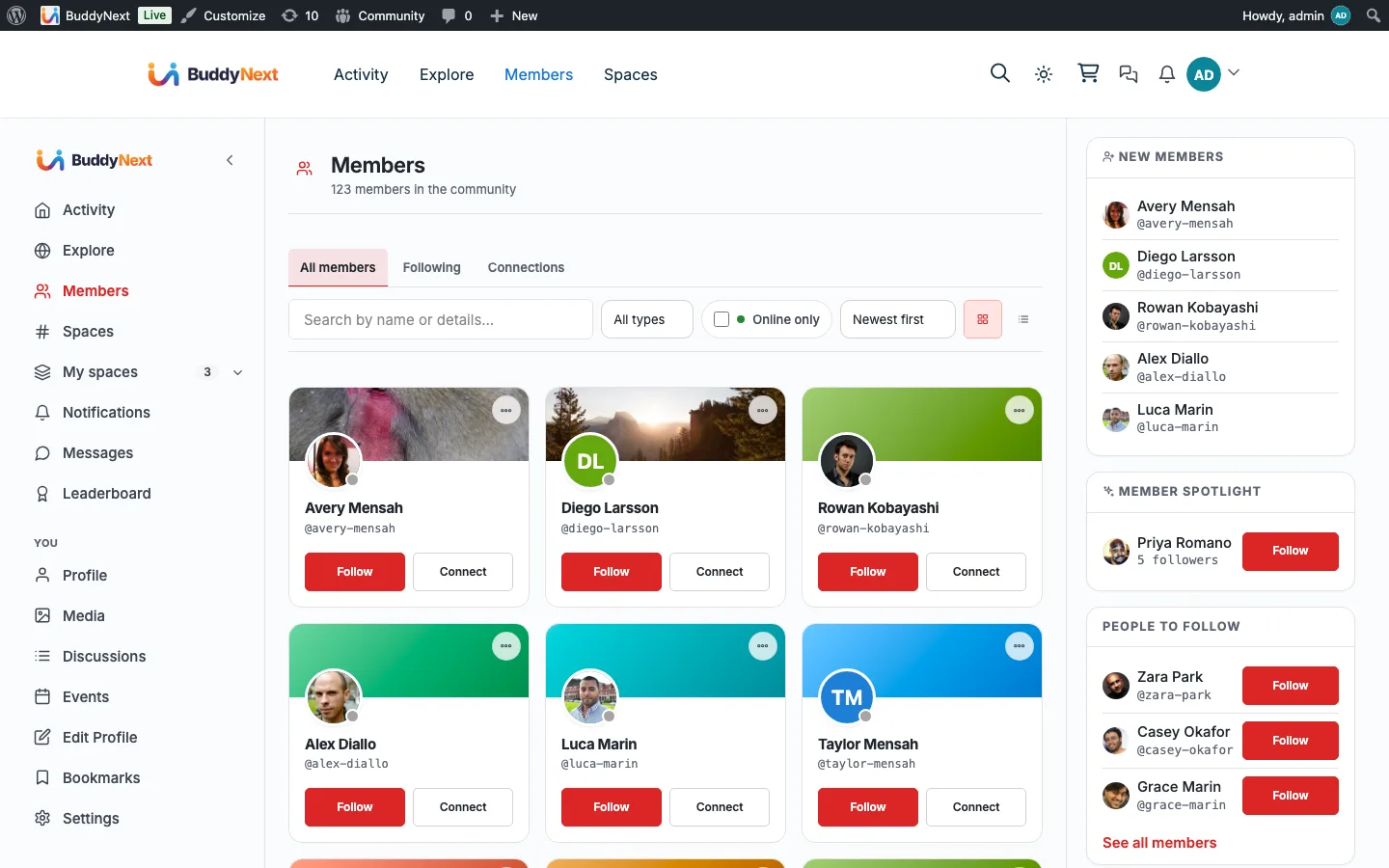
templates/parts/member-card.php is the high-value reusable card (avatar, name, handle, type badge, bio, mutual-connection count, the Follow / 5-state Connect / Message / kebab action cluster), shared by the member directory, search results, and space-members panels. It exposes the full four-hook contract. Its $args carry, among others: member (the WP_User), viewer_id, is_following, connection_state, mutual_count, member_type_label, bio, profile_url, avatar_url, and classes.
Worked example: add a badge to the member card
To append markup after the card, hook buddynext_part_member_card_after and read the member off $args:
add_action( 'buddynext_part_member_card_after', static function ( array $args ): void {
    $member = $args['member'] ?? null;
    if ( ! $member || ! isset( $member->ID ) ) {
        return;
    }
    if ( ! get_user_meta( (int) $member->ID, 'my_addon_is_pro', true ) ) {
        return;
    }
    printf(
        '<span class="bn-badge my-pro-badge" data-tone="accent">%s</span>',
        esc_html__( 'Pro member', 'my-addon' )
    );
} );
To add a CSS class to the card root instead of markup, use the _classes filter (it receives the class array and $args):
add_filter( 'buddynext_part_member_card_classes', static function ( array $classes, array $args ): array {
    $member = $args['member'] ?? null;
    if ( $member && isset( $member->ID ) && get_user_meta( (int) $member->ID, 'my_addon_is_pro', true ) ) {
        $classes[] = 'is-pro';
    }
    return $classes;
}, 10, 2 );
The member card also exposes two pre-escaped HTML overlay filters for richer additions without _after: buddynext_member_card_meta_html (a meta-overlay slot, receives '', $member_id, $args) and buddynext_avatar_overlay_html (an avatar corner overlay, receives '', $member_id, 'xl'). Whatever you return from these is echoed raw, so escape it yourself.
Injecting more than one chip? Wrap the row in .bn-badge-row. When an overlay filter returns several .bn-badge chips (e.g. Moderator + Verified + Expert), wrap them in a single .bn-badge-row element so they are evenly spaced and wrap cleanly: '<span class="bn-badge-row">' . $chip_a . $chip_b . '</span>'. It is a shared, token-driven, RTL-safe primitive in bn-base.css. Free also backstops the known overlay containers (.bn-post-card__author, .bn-md-card__meta-overlay, .bn-md-card__labels, .bn-comment__author-meta) with adjacent-chip spacing, so chips never collide even without the wrapper - but the wrapper is the recommended path and the only one that spaces chips consistently on every surface.
The notification row
templates/parts/notification-row.php is a pure presenter: every notification's message, deep-link URL, icon, tone, and pill label are pre-composed by NotificationMessageService::compose() (includes/Notifications/NotificationMessageService.php) and handed in via $args['payload']. The row exposes the standard four hooks (buddynext_part_notification_row_{args,classes,before,after}), but the important consequence is upstream:
Adding a new notification type is a service change, not a template change. Every type has an exhaustive case in NotificationMessageService::compose_single() (and compose_grouped() for collapsible types) that returns its copy, plus a meta_for() entry for its icon/tone/label and a url_for() entry for its deep link. Add those cases and the row renders your type with no template edit. A type with no case is a presentation bug (the legacy fallback string was removed), so wire all three: message, meta, URL.
To restyle a specific type's row, branch on the type inside a _classes filter:
add_filter( 'buddynext_part_notification_row_classes', static function ( array $classes, array $args ): array {
    $row = $args['notif_row'] ?? null;
    if ( $row && 'my_addon_mention' === ( $row->type ?? '' ) ) {
        $classes[] = 'is-mention';
    }
    return $classes;
}, 10, 2 );
The post card
templates/partials/post-card.php is different from the parts above: it is a thin composer, not a leaf card. It resolves shared post state once, then delegates each UI region to a templates/parts/post-*.php part:
| Region part | Renders |
|---|---|
post-byline.php |
Author row, degree pill, inline Follow, options menu |
post-options-menu.php |
The kebab menu (rendered inside the byline) |
post-cw-overlay.php |
The content-warning overlay |
post-body.php |
Text, media, link preview, poll, shared-post embed |
post-reaction-summary.php |
The engagement chip strip |
post-actions.php |
React / Comment / Share / Save toolbar |
post-comments-list.php |
The thread |
post-comment-form.php |
The comment composer |
Each region part exposes its own four-hook contract (for example buddynext_part_post_actions_after, buddynext_part_post_byline_classes). Customize a region through its part hooks - never fork post-card.php. Adjusting the action toolbar means hooking buddynext_part_post_actions_*, not copying the whole card.
Gotcha: the composite partials do not expose the top-level four-hook contract
templates/partials/post-card.php and templates/partials/explore-card.php are composers - they do not fire buddynext_part_post_card_* or buddynext_part_explore_card_* hooks of their own. To customize them you have three paths, in order of preference:
- Hook a delegated region part (
buddynext_part_post_byline_after,buddynext_part_post_actions_classes, and so on). This is the supported, update-safe path for almost everything. - Use the content filters the composer already exposes. For example
buddynext_byline_show_follow(receivestrue, $post_author_id, $post_id) suppresses the inline byline Follow button; returnfalseto remove it. - Override by copy as a last resort (see the child-theme template overrides page) -
post-card.phpcarries anOverridable:header, but a copied composer drifts from the region parts on the next release, so prefer 1 and 2.
// Remove the inline Follow button from every post byline.
add_filter( 'buddynext_byline_show_follow', '__return_false' );

// Add a class to the post action toolbar when the post is bookmarked.
add_filter( 'buddynext_part_post_actions_classes', static function ( array $classes, array $args ): array {
    if ( ! empty( $args['is_bookmarked'] ) ) {
        $classes[] = 'is-bookmarked';
    }
    return $classes;
}, 10, 2 );
The shared primitives
The reusable primitives under templates/parts/ (empty-state, pagination, sidebar-card, section-head, stat-strip, filter-strip) all follow the same four-hook contract, plus a few part-specific extras documented in each part's PHP file header under templates/parts/ (Free ships no docs/specs/TEMPLATE-PARTS.md). Render one with buddynext_get_template( 'parts/{name}.php', $args ), and customize it with its _args / _classes / _before / _after hooks. Notable extras:
filter-stripaddsbuddynext_part_filter_strip_tabs(filter the tab list) and abuddynext_part_filter_strip_extrasaction (inject fields into the form).sidebar-cardadds a contextualbuddynext_part_sidebar_card_body__{id}action that fires inside the body slot when the card is given anid.paginationaddsbuddynext_part_pagination_paginate_argsto filter the underlyingpaginate_links()args.
// Inject a moderator-only tab into a filter strip.
add_filter( 'buddynext_part_filter_strip_tabs', static function ( array $tabs, array $args ): array {
    if ( ! current_user_can( 'edit_posts' ) ) {
        return $tabs;
    }
    $tabs[] = array(
        'key'   => 'flagged',
        'label' => __( 'Flagged', 'my-addon' ),
        'icon'  => 'flag',
        'href'  => add_query_arg( 'filter', 'flagged' ),
    );
    return $tabs;
}, 10, 2 );
Notes / gotchas
- Filters return, actions echo. The
_argsand_classesfilters must return the (possibly modified) array; the_before/_afteractions output directly, so escape every value you emit. - Read the part's
@varheader for the real$argskeys. Each file documents what it receives - do not guess key names. - Hook the region, never fork the composer. For the post card and explore card, customize the delegated
post-*parts, the content filters, or (last resort) override by copy - the composite partials have no top-level four-hook contract. - New notification type = service case. Add the
compose_single/meta_for/url_forcases inNotificationMessageService; the row template needs no change. - Overlay HTML filters echo raw.
buddynext_member_card_meta_html,buddynext_avatar_overlay_html, and the post overlay filters output what you return without escaping - escape at source.
See also Hooks: Template Parts for the full hook family, Overriding templates in a child theme for the copy-and-override path, and the Navigation API for adding tabs rather than cards.